Thursday, 30 March 2017

Crude settles above $50 amid optimism for OPEC deal extension - Sean Seshadri

Crude futures settled higher on Thursday, amid optimism that an OPEC led production cut deal would be extended beyond June, following bullish comments from Kuwait oil chief Essam al-Marzouq.
On the New York Mercantile Exchange crude futures for May delivery gained 84 cents to settle at $50.35 a barrel, while on London's Intercontinental Exchange, Brent gained 61 cents to trade at $53.15 a barrel.
Crude futures settled above the key $50-level, as crude prices hit a three-week high of $50.45, after Kuwait oil minister Essam al-Morzouq said his country was among several nations that supported the idea of extending the current deal between OPEC and non-OPEC members beyond June.
In November last year, OPEC and other producers, including Russia agreed to cut output by about 1.8 million barrels per day (bpd) in an effort to combat the oversupply issue that has pressured prices over the last two years.
OPEC members have been high compliance with the deal to cut supply, which came into effect in January this year, while a ramp up in U.S. production of shale and crude has weighed on oil prices.
Despite, a dip in crude inventories on Wednesday, crude stockpiles remain at record highs – at over 520 million barrels, current crude supplies are up 6% over the past year. Rising U.S. crude stockpiles sparked concerns that OPEC may struggle to drain the glut in supply.
Meanwhile, market participants turn attention to Baker Hughes rig count, due to be released on Friday at 14:00 EDT.

Crude prices dip in Asia after early gains, rig count eyed - Sean Seshadri

Crude prices reversed course and fell in Asia on Thursday as investors moved on from a lower than expected build in U.S. crude stocks and a supply disruption in Libya and awaited the latest weekly rig count data at the end of the week from the U.S. for further guidance.
On the New York Mercantile Exchange crude futures for April delivery fell 0.02% to $49.49 a barrel, while on London's Intercontinental Exchange, Brent eased 0.19% to $52.44 a barrel.
Meanwhile, market participants turn attention to Baker Hughes rig count, due to be released on Friday at 13:00 EDT. Data last weekrevealed that the number of active U.S. rigs drilling for oil rose by 21, the tenth weekly increase in a row. That brought the total count to 652, the most since September 2015.
© Reuters.  Crude dips in Asia
Overnight, crude futures settled higher on Wednesday, after the latest Energy Information Administration (EIA) report showed a smaller than expected rise in U.S. crude stockpiles while output disruptions in Libya continued to lift sentiment.
Oil prices continued to rebound for a second straight session, buoyed by bullish crude inventories data and continued output disruption in Libya.
For the week ending March 22, The EIA said that crude oil inventories rose by 0.867 million barrels compared to estimates of an increase of 1.357 million barrels.
Gasoline inventories dipped by 3.747 million against expectations for a drop of 1.886 million barrels while distillate stockpiles fell by 2.483 million barrels, compared to expectations of a 1.886 million decline.
Elsewhere, armed factions at the western Libyan oil fields of Sharara and Wafa continued to block production, reducing output by 252,000 barrels per day (bpd), about a third of production.
Crude futures are on tentative path to recovery and settled above $49 for the first time in nine days amid worries that growing U.S. crude inventories to record levels would dampen OPEC’s effort to tackle the oversupply issue in the industry.
In November last year, OPEC and other producers, including Russia agreed to cut output by about 1.8 million barrels per day (bpd) in an effort to combat the oversupply issue that has pressured prices over the last two years.

Monday, 27 March 2017

Gold gains in early Asia as political risk events eyed - Sean Seshadri

Gold prices gained in early Asia on Monday as investors see a week of political risk events, including Britain's move to formally start its break from the European Union.
Prime Minister Theresa May will set out how her government plans to restore sovereignty over Britain's laws on Thursday, publishing a detailed paper on ending "the supremacy of EU lawmakers," according to Reuters.
Gold for April delivery rose 0.73% to $1,252.90 on the Comex division of the New York Mercantile Exchange.
On Monday, the Ifo Institute will report on German business climate and Federal Reserve Bank of Chicago President Charles Evans and Dallas Fed President Robert Kaplan are scheduled to speak.
© Reuters.  Gold up in Asia
In the week ahead, investors will be continuing to monitor political developments in the U.S., as Trump’s promised tax reforms come into focus.
Expectations that the Trump administration would spur growth and inflation through fiscal stimulus pushed the dollar to 14-year highs in the weeks after the election.
But the greenback has weakened in recent week as it became apparent that the White House would have difficulty in delivering on its legislative agenda.
Last week, gold prices retraced gains late Friday but still notched up a second weekly rise as concerns over the Trump administration’s ability to push through its pro-growth economic agenda underpinned safe haven demand.
Prices of the precious metal turned lower as the dollar steadied after Republican leaders dropped legislation to replace the Affordable Care Act before a planned vote in the House of Representatives, after it failed to gather enough support to pass.
Investors viewed the Trump administration's failure to push through a healthcare overhaul as a sign he may also face further setbacks delivering on other policy pledges including corporate tax cuts, regulatory reform and infrastructure spending.

Thursday, 23 March 2017

Gold dips in Asia in light regional data day, U.S. eyed - Sean Seshadri

Gold prices eased in Asia on Thursday in a light regional data day as markets look to U.S. politics over healthcare for risk direction with a key vote expected in Congress.
Gold for April delivery on the Comex division of the New York Mercantile Exchange eased 0.29% to $1,246.05 a troy ounce, while copper was last quoted at $2.639 a pound.
Overnight, gold prices traded higher on Wednesday, as investors piled into the yellow-metal amid doubts over President Trump's economic policies while weaker than expected economic data supported upside momentum.
© Reuters. Gold dips in Asia
Gold prices continued to trade near session highs, as investors focused on the lack of progress concerning the Trump administration’s pro-growth policies ahead of a key House vote on Thursday.
House Republicans plan to vote on their bill to repeal and replace the Affordable Care Act on Thursday.
Meanwhile weaker than expected U.S. home resales weighed on the U.S. dollar and added a layer of supported for dollar-denominated gold.
The National Association of Realtors said on Wednesday existing home sales declined 3.7% to a seasonally adjusted annual rate of 5.48 million units last month.

Wednesday, 22 March 2017

Gold hits fresh 3-week highs amid Trump policy jitters - Sean Seshadri

Gold prices rose to a three-week high during European morning hours on Wednesday, as growing doubts about U.S. President Donald Trump's pro-growth economic agenda prompted investors to dump risky assets and rush to safe havens.
Comex gold futures reached a session peak of $1,249.05 a troy ounce, the highest since February 28. It was last at $1,247.00 by 4:20AM ET (08:20GMT), up 50 cents, or less than 0.1%.
It settled higher for the fourth session in a row on Tuesday, as risk-averse investors sought safer investments amid a weak dollar and as U.S. equities tumbled on doubts over the implementation of President Trump's economic agenda.
Meanwhile, spot gold was up $3.95 at $1,248.55 per ounce.
© Reuters.  Gold hits fresh 3-week highs as Trump jitters boost demand
Headlines from Washington will continue to be in focus, as House Republicans are expected to vote on repealing and replacing the Affordable Care Act on Thursday.
The Freedom Caucus, a key group of House Republicans, threatened to issue a formal statement of opposition to the Obamacare replacement bill, which would delay the vote, unless the language in the bill changes dramatically.
Appetite for riskier assets took a hit on concerns the House will not have enough votes to repeal and replace the healthcare bill, triggering worry that more of the Trump Administration's pro-growth policies could be delayed or derailed in Congress.
Global stock markets sold off as investors unwound bets from a post-election rally on worries that Trump would not be able to live up to his promises for large-scale reform on tax and regulation.
Meanwhile, the U.S. dollar index, which measures the greenback’s strength against a trade-weighted basket of six major currencies, was little changed near a seven-week low of 99.53 in London morning trade.
U.S. Treasury yields traded lower, with the benchmark 10-year note yield falling to a three-week low of 2.405%.
The greenback, along with Treasury yields, have been on the retreat since the Fed raised interest rates on Wednesday last week, but stuck to its outlook for two more hikes this year, instead of three expected by the market.
The precious metal is sensitive to moves in U.S. rates, which lift the opportunity cost of holding non-yielding assets such as bullion.
A gradual path to higher rates is seen as less of a threat to gold prices than a swift series of increases.

Oil sink to 4-month lows on bets for bearish U.S. supply data - Sean Seshadri

Oil prices were under pressure during European morning hours on Wednesday, falling to the lowest level since the end of November after data overnight showed another increase in U.S. crude supplies.
The U.S. West Texas Intermediate crude May contract shed 78 cents, or around 1.6%, to $47.46 a barrel by 6:10AM ET (10:10GMT), a level not seen since November 30.
The U.S. benchmark settled lower for the third session in a row on Tuesday as the market weighed rising U.S. drilling and growing stockpiles against efforts by major producers to cut output to reduce a global glut.
© Reuters.  Oil falls to fresh 4-month lows ahead of U.S. supply data
Elsewhere, Brent oil for May delivery on the ICE Futures Exchange in London sank 84 cents to $50.12 a barrel. The global benchmark touched $50.06 earlier, its cheapest since November 30.
After markets closed Tuesday, the American Petroleum Institute said that U.S. oil inventories rose by 4.5 million barrels in the week ended March 17.
The API report also showed a drop of 4.9 million barrels in gasoline stocks, while distillate stocks declined 880,000 barrels.
The U.S. Energy Information Administration will release its official weekly oil supplies reportat 10:30AM ET (14:30GMT) Wednesday. If the increase is confirmed, it would be the 11th weekly build in the past 13 weeks.
Oil has fallen sharply this month amid concern that the ongoing rebound in U.S. shale production could derail efforts by other major producers to rebalance global oil supply and demand.
OPEC agreed in November last year to curb its output by about 1.2 million barrels per day between January and June. Russia and 10 other non-OPEC producers have agreed to jointly cut by an additional 600,000 barrels per day.
In total, they agreed to reduce output by 1.8 million barrels per day to 32.5 million for the first six months of the year, but so far the move has had little impact on inventory levels.
OPEC's latest monthly report showed global oil stocks in January rose to 278 million barrels above the five-year average.
OPEC members increasingly favor extending the output curb beyond June to balance the market, sources within the group said, although they added that this would require non-OPEC members such as Russia to also step up their efforts.
Kuwait is scheduled to host a ministerial meeting on March 26 comprising both OPEC and non-OPEC members to review compliance with the output agreement and to discuss whether cuts would be extended beyond June.
Elsewhere on Nymex, gasoline futures for April shed 1.3 cents, or 0.9%, to $1.595 a gallon, while April heating oil slipped 1.9 cents to $1.483 a gallon.
Natural gas futures for April delivery slumped 2.2 cents to $3.071 per million British thermal units.

Tuesday, 21 March 2017

Oil rebounds on talk of output cut deal extension - Sean Seshadi

Oil was higher Tuesday on talk of a possible extension of the output cuts agreed by major producers.
U.S. crude was up 37 cents, or 0.76%, at $49.28 at 08:00 ET. Brent crude rose 38 cents, or 0.74%, to $52.00.
OPEC and non-OPEC producers are cutting output by 1.8 million barrels a day in the first half.


But the reduction in output has so far failed to re-balance the oil market as U.S. output increases.
Oil had fallen Monday as Baker Hughes data showed a further rise in the number of rigs operating in the U.S.
American Petroleum Institute U.S. crude stocks figures are due out later in the session.
These will be followed Wednesday by official Energy Information Administration inventories

Monday, 20 March 2017

U.S. natural gas futures rise back toward $3 - Sean Seshadri

U.S. natural gas futures extended gains to a second session on Monday, as forecasts showing cooler weather on the way boosted the heating fuel.
U.S. natural gas for April delivery rallied 4.3 cents, or around 1.5% to $2.990 per million British thermal units by 9:40AM ET (13:40GMT).
Cool temperatures will sweep across the Great Lakes and eastern U.S. toward the middle of the week, according to forecasters at NatGasWeather.com, with overnight lows expected to drop well below freezing.
Temperatures are expected to remain much colder than normal through the end of the week, with highs struggling to reach the 30s, while overnight lows drop into the teens to below 0F.
© Reuters.  U.S. natural gas futures kick the week off with gains
A fast-moving weather system will then impact the east-central U.S. Saturday into Sunday, followed by warming Monday, but again cooling off mid-week.
Prices of the heating fuel are down around 20% so far this year as forecasts for warm winter weather weighed on heating demand expectations.
Based on data from the National Oceanographic and Atmospheric Administration, this year’s extremely warm winter has pushed heating demand for natural gas to nearly 20% below average.
About half of U.S. homes use natural gas for heating.
Without significant demand for natural gas, inventories could stay near record levels and may even continue to pull prices even lower.
Market participants looked ahead to weekly storage data due on Thursday, which is expected to show a draw in a range between 150 and 160 billion cubic feet in the week ended March 17.
That compares with a withdrawal of 53 billion cubic feet in the preceding week, a build of 15 billion a year earlier and a five-year average drop of 21 billion cubic feet.
Total natural gas in storage currently stands at 2.295 trillion cubic feet, according to the U.S. Energy Information Administration, 7.7% lower than levels at this time a year ago but 15.8% above the five-year average for this time of year.

Friday, 17 March 2017

Oil prices dip as doubts remain over OPEC supply cuts - Sean Seshadri

Oil prices dipped on Friday as the market looked for clues on how effectively OPEC production cuts are working to absorb a global supply overhang.
Brent crude was down 10 cents, or 0.19 percent, at $51.64 per barrel, as of 0745 GMT.
U.S. West Texas Intermediate crude (WTI) edged down 3 cents, or 0.06 percent, at $48.72 a barrel.
Oil prices fell sharply last week on concerns that production cuts by OPEC and non-OPEC members, including Russia, are not cutting a supply overhang as quickly as expected in the face of increased U.S. output.
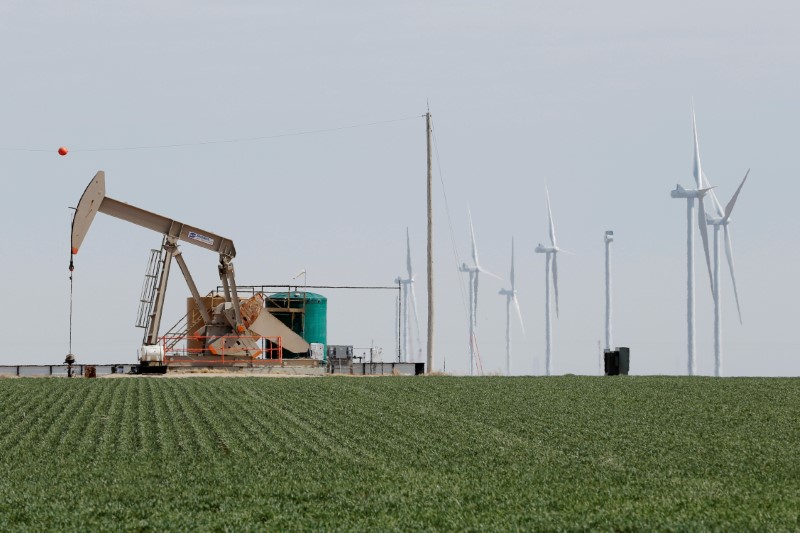
© Reuters. An oil derrick and wind turbines stand above the plains north of Amarillo, Texas
"Saudi Arabian Energy Minister Khalid Al-Falih continued to express concern about high global inventories," ANZ said in a note. "However, he did reiterate that the market is currently going in the right direction and fundamentals had improved."
If crude inventories remain high, the Organization of Petroleum Exporting Countries (OPEC) could extend its oil output cut deal, the Saudi energy minister said on Thursday.
"Much talk has been made of OPEC, non-OPEC compliance, but the fact is, that when you dig into the numbers, only Saudi Arabia has been pulling its weight," said Jeffrey Halley, senior market analyst at OANDA brokerage in Singapore.
Official data showed crude inventories in the United States, the world's top oil consumer, fell last week as imports plunged, dropping after nine consecutive increases.
Crude stockpiles fell by 237,000 barrels in the week to March 10, beating analyst expectations for an increase of 3.7 million barrels.
OPEC and non-OPEC members including Russia reached a landmark agreement last year to cut output by almost 1.8 million barrels per day (bpd) in the first half of 2017.
But OPEC's monthly report showed global oil inventories increased in January to 278 million barrels above the five-year average.
In a sign that OPEC's efforts have had little impact, oil shipments to Asia have increased 3 percent since the OPEC supply cut deal was made.
Iraq's March oil exports have averaged 3.25 million barrels-per-day in the first 14 days of the month, slightly lower than February's 3.27 million bpd. But the decline was not as much as expected, which could raise doubts over the country's compliance with the OPEC supply cut deal.