Monday, 29 May 2017

Oil dips as U.S. drilling undermines drive to tighten markets - Sean Seshadri

Oil prices dipped on Monday as a relentless rise in U.S. drilling undermined an OPEC-led push to tighten supply.
Trading activity will be subdued on Monday due to public holidays in China, the United States and Britain.
Brent crude futures were trading down 6 cents at $52.09 per barrel at 0645 GMT.
U.S. West Texas Intermediate (WTI) crude futures were down 8 cents at $49.72 per barrel.
The Organization of the Petroleum Exporting Countries and some non-OPEC producers agreed last week to extend a pledge to cut production by around 1.8 million barrels per day (bpd) until the end of the first quarter of 2018. But the decision did not go as far as many investors had hoped and led to a heavy sell-off.

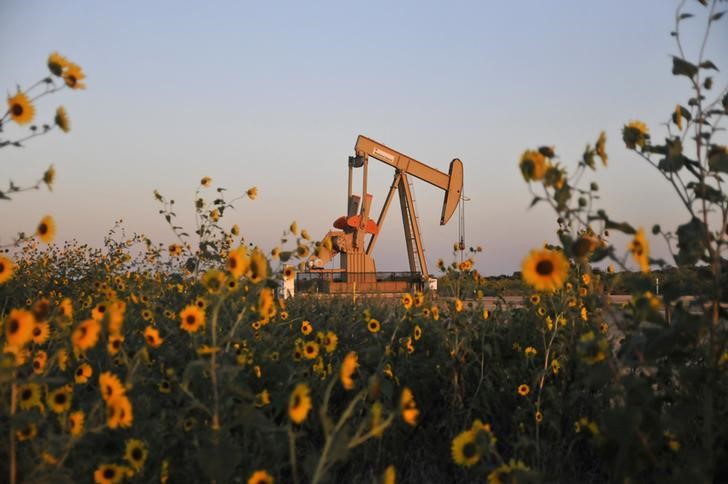
© Reuters. FILE PHOTO: An oil pump jack pumps oil in a field near Calgary
An initial agreement, in place since January, would have expired in June this year.
"The immediate market reaction to the May 25 OPEC decision is indicative of the weaker-than-expected impact production cuts had on bloated global crude stocks over H1 2017," BMI Research said in a note.
Despite the ongoing cuts, oil prices have not risen much beyond $50 per barrel.
Much of OPEC's success will depend on output in the United States, which is not participating in the cuts and where production has soared 10 percent since mid-2016 to over 9.3 million bpd, close to top producer levels Russia and Saudi Arabia.
U.S. drillers have now added rigs for 19 straight weeks, to 722, the highest amount since April 2015 and the longest run of additions on record, according to energy services firm Baker Hughes Inc.
Almost all of the recent U.S. output increases have been onshore, from so-called shale oil fields.
Even if the rig count did not rise further, Goldman Sachs (NYSE:GS) said it estimates that U.S. oil production "would increase by 785,000 bpd between 4Q16 and 4Q17 across the Permian, Eagle Ford, Bakken and Niobrara shale plays."
Analysts say that reducing bloated global fuel inventories will be key to reining in ongoing oversupply.
"It's going to be all about inventories and whether they fall as much as OPEC thinks," said Greg McKenna, chief market strategist at futures brokerage AxiTrader.
While it is hard to come by reliable global oil inventory data, regional stock levels for the United States, Europe and parts of Asia suggest that inventories have dipped in recent weeks, albeit from record levels.

Friday, 19 May 2017

Oil prices climb on hopes output cuts will be extended - Sean Seshadri

Oil futures rose in early trading on Friday on growing optimism that big producing countries will extend output cuts to curb a persistent glut in crude, with key benchmarks heading for a second week of gains.
Brent crude (LCOc1) was up 12 cents at $52.63 at 0006 GMT, after settling up half a percent on Thursday. The contract is on track for a 3.5-percent climb this week, a second week of gains.
U.S. crude oil (CLc1) was up 14 cents at $49.49 a barrel, after finishing the previous session at $49.35 a barrel, the highest close since April 26. The contract is heading for a weekly increase of 3.4 percent.
© Reuters. A pump jack operates at a well site leased by Devon Energy Production Company near Guthrie, Oklahoma
Oil prices have been trapped in a tight range in recent weeks as rising U.S. production has erased the effects of output cuts by the Organization of Petroleum Exporting Countries (OPEC) and other countries, including Russia.
But market watchers are growing more confident that OPEC, Russia and other big producers will extend cuts of almost 1.8 million barrels per day (bpd) until the end of March 2018. U.S. producers are not party to any agreements capping production.
On May 25, leaders from OPEC and other producing countries will meet in Vienna to decide on output policy.
Rosneft, the largest oil producer in Russia will meet agreements with the grouping on oil output reductions, the company's chief executive told reporters in Berlin on Thursday.

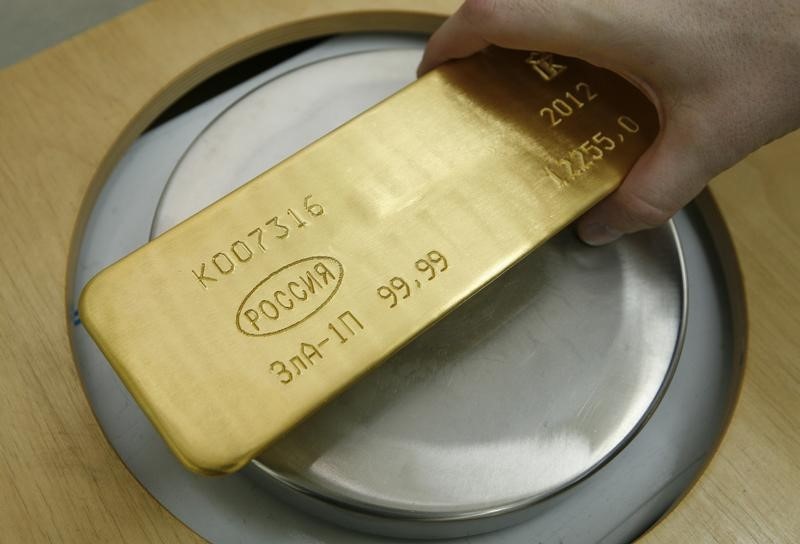
Gold gains in Asia on heightened risk sentiment - Sean Seshadri

Gold gained in Asia on Friday on heightened risk sentiment over political turmoil in Brazil and the U.S. and a potentially softer outlook for Fed rate hikes this year as the Trump administration faces headwinds on its economic stimulus plans.
Gold for June delivery on the Comex division of the New York Mercantile Exchange eased 0.21% to $1,250.19 a troy ounce. Copper future on the Comex gained 0.08% to $2.534 a pound.
Overnight, gold futures pulled back from two-week highs on Thursday, after stronger U.S. manufacturing and initial jobless claims data dented the ‘flight to safety’ trade.
Demand fell for traditional safe-havens such as gold, U.S. treasuries, and the yen, as investors turned attention to better than expected U.S. economic data, despite continued political turmoil in Washington.
© Reuters.  Gold gains in Asia
The Federal Reserve Bank of Philadelphia said Tuesday that its Philly Fed manufacturing index rose to a seasonally adjusted 38.8, from 22.0 in the preceding month, well above analysts’ expectations of a rise to 19.5.
In a separate report on Tuesday, The Labor Department said the number of Americans who filed for unemployment insurance for the week ended May 12, dropped by 4000 to 232,000.
The release of upbeat economic data came amid continued U.S. political turmoil in Washington, after the Justice Department appointed former FBI Director Robert Mueller as a special counsel to lead a federal investigation into allegations that Trump collaborated with Russia during the 2016 election.
Meanwhile, Cleveland Federal Reserve Bank President Loretta Mester on Thursday repeated her call for further U.S. interest rate hikes in the wake of recent U.S. economic data, showing that the rate of employment and inflation is close to matching the Fed’s objectives.
According to investing.com’s Fed rate monitor tool 61% of traders expect the Federal Reserve to hike its benchmark rate in June, compared to nearly 80% of traders in the previous week.

Crude stages mild rally in Asia ahead of U.S. rig count figures - Sean Seshadri

Crude prices staged a mild rally in Asia on Friday with U.S. crude nearing the key $50 a barrel mark ahead of weekly rig count figures expected to set the near-term tone ahead of next week's meeting of OPEC and allied producers on production cuts.
On the New York Mercantile Exchange crude futures for June delivery rose 0.85% to $49.77 a barrel, while on London's Intercontinental Exchange, Brent gained 0.70% to $52.88 a barrel.
In figures reported last Friday, oilfield servcies firm Baker Hughes said U.S. drillers added 9 oil rigs to take the total to 712, rigs for the 17th weekly gain in a row and extending an 11-month drilling recovery to the highest level since August 2015, implying that further gains in domestic production are ahead.
Overnight, crude futures settled higher on Thursday, as investors remained optimistic that OPEC would reach an agreement to extend the current supply-cut deal beyond June at its meeting next week.
© Reuters.  Crude up in Asia
In what was a choppy day of trade, oil futures recovered from a more than 1% slump, as investors' optimism that OPEC would seek an extension of the current deal to cut global production offset concerns over the rising level of U.S. shale production.
The Energy Information Administration said Wednesday, crude oil inventories fell by 1.75 million barrels last week, which was the sixth-straight week of declining crude stockpiles but the dip in inventories fell short of expectations of a draw of around 2.4 million barrels.
Despite the high level of compliance from OPEC members with the deal to rein in supply, global production remains above the five-year average, as non-OPEC members, who are not part of the supply-cut agreement have ramped up production.
In its monthly report last Thursday, OPEC estimated that non-OPEC production this year would grow by 950,000 barrels per day (bpd).
OPEC and other producers are set to meet on May 25 to decide whether to extend the current supply-cut deal amid growing optimism for a prolonged period of cuts.
Saudi Arabia and Russia agreed earlier this week that production cuts needed to be extended for a period of nine months until March 2018.
The International Energy Agency (IEA) on Wednesday, however, warned that OPEC’s effort to rein in the glut in supply may fail even if the oil group agrees to extend its supply-cut agreement.